By Robin Singhvi · Founder, SmartCue · Updated April 29, 2026
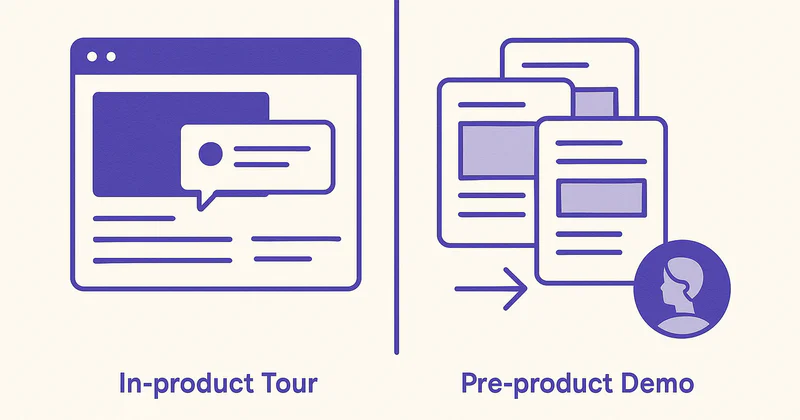
Most "best product tour software" lists you'll read this year are quietly broken. They mash twelve to fifteen vendors into a single ranked list and pretend the buyer's job is to pick the highest-rated one. The buyer's actual job is upstream of that: figure out which of the two adjacent product-tour categories you're actually shopping in, and then pick a tool inside the right category.
Here's my defended thesis for this post: most "best product tour software" rankings confuse two adjacent but distinct categories. In-product tours (Pendo, Appcues, Chameleon, WalkMe, Userpilot) guide existing users through your product after they've signed up. Pre-product interactive demos (SmartCue, Walnut, Storylane, Supademo, Navattic, Reprise, Arcade) show prospects what your product does before they sign up. Mixing them in one ranking is bad buyer advice. The right answer is two lists with a decision framework for which one you actually need.
I built SmartCue. SmartCue lives in the second category — pre-product interactive demos. So when SmartCue shows up in List 2 below, that's a vendor-of-record opinion. Use the framework to decide; don't take the listing order as gospel. I'll be specific about where each tool wins, including the ones that compete with mine.
How to decide which category you actually need
Before you compare vendors, ask one question: where does the user see this tour — before they sign up, or after?
If the answer is "after they've already created an account, logged in, and need help adopting the product" — you want an in-product tour. The user is already inside your application. The tour overlays on top of your real UI. The vendor injects a JavaScript snippet, watches the DOM, and shows tooltips, modals, and checklists tied to actual element selectors. This is the Pendo / Appcues / Chameleon / WalkMe / Userpilot category.
If the answer is "before they've signed up — on the marketing site, in a sales email, embedded in a G2 listing, in an outbound sequence" — you want a pre-product interactive demo. The user has never logged in. The tour is a captured, rebuilt, or screenshot-based simulation of your product hosted on the vendor's domain (or embedded on yours). This is the SmartCue / Walnut / Storylane / Supademo / Navattic / Reprise / Arcade category.
A few teams genuinely need both. Most teams convince themselves they need both and end up with two contracts, two operators, and two unhappy use cases. If you're early-stage, pick one. The category that matches your bigger problem right now wins.
Three sub-questions that sharpen the decision further:
Sub-question 1: Who is supposed to sit in the chair and build this? In-product tour platforms are built around product managers and product-led-growth operators. The audience is internal users; the success metric is feature adoption and time-to-value. Pre-product demo platforms are built around product marketers, sales engineers, and demand-gen owners. The audience is external prospects; the success metric is demo-to-opportunity rate and qualified pipeline.
Sub-question 2: Where does the buyer's ICP first encounter your product? If most of your pipeline comes from search, paid, and review-site referrals — prospects landing on your marketing site cold — pre-product demos move the needle. If most of your pipeline comes from existing free users converting to paid, in-product tours move the needle.
Sub-question 3: How sensitive is the user to seeing real production data? In-product tours run on the live product with real data. That's their power and their risk — every tooltip selector breaks when you ship a UI change. Pre-product demos run on a captured snapshot, which is brittle in a different way (re-capture when the UI changes) but perfectly safe — no real customer data ever leaves your environment.
If you answered cleanly toward "after signup, internal adoption, real data" — read List 1 and skip List 2. If you answered cleanly toward "before signup, external prospects, captured snapshot" — read List 2.

List 1 — In-product tour platforms (5 options)
These tools sit inside your live product and show real users tooltips, modals, checklists, and guided walkthroughs after they've logged in. The buyer is usually a head of product, head of PLG, or onboarding lead.
1. Pendo
Positioning. The category-defining product analytics + in-product guidance platform. Pendo bundles product analytics, in-product guides, NPS surveys, roadmap, and feedback into a suite. Used by enterprise product teams that want one vendor for the whole product-data stack.
Strength. Analytics depth. Pendo's session-level event capture and feature usage data is the deepest in the category, and the guides build on top of that data. If you want to trigger a tour only for users who've used Feature A but not Feature B in the last 30 days, Pendo handles it natively.
Pricing band. Mid-five-figures to low-six-figures annually for serious deployments. Pricing is opaque and sales-led; the public site doesn't post numbers. Expect a long sales cycle.
When it's the right fit. Mid-market and enterprise SaaS with a dedicated product ops function, real money to spend on product analytics, and a willingness to consolidate four tools into one vendor. Overkill for early-stage teams.
2. Appcues
Positioning. The PLG-native in-product onboarding tool. Appcues focuses tightly on flows, checklists, and tooltips that drive activation and feature adoption. Less analytics, more onboarding execution.
Strength. Time-to-first-flow. A non-technical product manager can ship a working onboarding flow in an afternoon. The editor is the cleanest in the in-product category, and the targeting rules are flexible without being a full segmentation engine.
Pricing band. Starts around four-figures annually for the entry plan; mid-five-figures for serious mid-market deployments. Pricing is partially public.
When it's the right fit. PLG SaaS with a clear activation funnel, a product manager who owns onboarding end-to-end, and no immediate need for the full Pendo-style analytics suite. Strong fit for Series A through Series C.
3. Chameleon
Positioning. Designer-friendly in-product onboarding with the most flexible visual customization in the category. Strong on tour aesthetics; the tooltips and modals look native to your product rather than visibly bolted on.
Strength. Visual fidelity. Chameleon tours look like they belong inside your product. For brand-conscious teams that bristle at "vendor-looking" tooltips, the visual control is the differentiator.
Pricing band. Starts in the mid-three-figures monthly for the entry plan; scales up with monthly active user count.
When it's the right fit. Brand-led SaaS where the marketing or design team has veto rights over what shows up in the product. Strong for B2B SaaS with a polished UI investment.
4. WalkMe
Positioning. The enterprise-grade digital adoption platform. WalkMe goes beyond product tours into full digital adoption — onboarding, training, in-app support across multiple internal applications. Often deployed by IT/operations rather than product.
Strength. Enterprise breadth. WalkMe handles complex multi-application workflows (Salesforce + Workday + custom internal tools) with one platform. The depth of customization, governance, and rollout tooling is built for global enterprises.
Pricing band. Six-figures annually for enterprise deployments. Heavily sales-led; not a self-serve tool.
When it's the right fit. Enterprise IT or HR rolling out internal tools to thousands of employees across business units. Overkill for product teams shipping onboarding for a single SaaS product.
5. Userpilot
Positioning. Mid-market PLG-focused in-product onboarding. Closer to Appcues in spirit; aimed at growth and product teams that want flows + light analytics + experimentation in one tool.
Strength. Pricing-to-feature ratio in the mid-market. Userpilot lands roughly where Appcues sits on capability but tends to come in at a friendlier mid-market price point. Solid built-in NPS and survey tooling.
Pricing band. Starts in the mid-three-figures monthly; scales with monthly active user count.
When it's the right fit. Mid-market PLG SaaS with a head of product or growth owning activation, a real onboarding budget but not Pendo money, and a preference for one tool over a stack.
List 2 — Pre-product interactive demo platforms (7 options)
These tools sit outside your product. Prospects who haven't signed up yet experience a captured, rebuilt, or simulated walkthrough on the vendor's domain (or embedded on yours). The buyer is usually a head of product marketing, head of demand gen, or VP sales.
6. SmartCue
Positioning. The self-serve interactive demo platform. Self-serve onboarding, transparent pricing, fully functional free tier. Used by 4,000+ teams including Personify Health, Creditsafe, OneDigital, League, Quisitive, and Dario Health, generating well over 1.5 million viewer interactions across nearly 10,000 published demos. Built by a one-person AI-native company.
Strength. Time-to-first-demo plus transparent economics. A PMM signs up, captures a demo with the Chrome extension, edits about 12 steps, and ships in roughly 6 minutes. No sales call, no quote, no implementation services. Pricing is published: $99/user/year for Essential, $300/user/year for Growth.
Pricing band. $99/user/year (Essential) and $300/user/year (Growth). Public, posted, no quote required. Five seats on Essential is roughly $495/year — orders of magnitude lower than the sales-led incumbents in the category.
When it's the right fit. B2B SaaS that runs on HubSpot, has a PMM (or AE) who'll own demos directly, and prefers transparent self-serve pricing over a sales-led contract. Particularly strong for Series A through Series C teams that don't want to negotiate seat counts every renewal. Honest disclosure: I built this. The framework is what should drive your decision; the listing order is incidental.
7. Walnut
Positioning. The original sales-led interactive demo category leader. Heavy enterprise positioning, deep sales workflow integration, white-glove onboarding. Targets large sales orgs running enterprise outbound.
Strength. Sales-team-shaped workflow. Walnut's editor and analytics are built around the deal cycle — per-account demo variants, deal stage tracking, sales rep ownership. If your demo program is owned by a 50-person AE org, the workflow fits.
Pricing band. Roughly the high-three-figures to mid-four-figures per month range based on customer-reported numbers; pricing is not publicly posted and is sales-led at most tiers. Expect a custom quote.
When it's the right fit. Enterprise sales-led SaaS with a large AE org, a dedicated demo ops function, and budget for white-glove onboarding. Wrong fit for self-serve PLG teams.
8. Storylane
Positioning. Mid-market interactive demo with both HTML-capture and screenshot-based modes. Strong middle-of-the-road option between sales-led incumbents and pure self-serve.
Strength. Capture flexibility. Storylane offers both screenshot stitching (works for any UI, including ones the Chrome extension struggles with) and HTML capture (more interactive, prospect can click through). That flexibility covers more product types than capture-only platforms.
Pricing band. Starts in the low-three-figures monthly for the entry plan; mid-four-figures monthly for team plans. Pricing is partially public.
When it's the right fit. Mid-market B2B SaaS where the product has tricky UI patterns (canvas, custom rendering) that pure HTML capture struggles with. Solid generalist pick.
9. Supademo
Positioning. Self-serve interactive demo platform with strong AI-voiceover and AI-text-generation features baked in. Closest direct self-serve competitor to SmartCue at the workflow level.
Strength. AI features at the entry tier. Supademo bundles AI voiceover, AI-generated step text, and AI translation into the standard plans rather than gating them behind enterprise pricing. For teams that want AI-assisted demo production from day one, the bundling fits.
Pricing band. Free tier exists; paid plans start in the low-three-figures monthly. Public.
When it's the right fit. Self-serve B2B SaaS where AI-assisted text and voiceover are first-class requirements rather than nice-to-haves. Overlapping use case with SmartCue; pick on AI-feature density vs. transparent annual pricing.
10. Navattic
Positioning. Pre-product demos optimized for the website embed use case. Heavy focus on website-CTA-replacement workflows: replacing "Book a demo" with "Try the demo" on the marketing site.
Strength. Embed-on-marketing-site polish. Navattic's embeds load fast, look native to marketing sites, and the analytics are tuned to demand-gen metrics (demo views by traffic source, conversion to lead, lead-quality scoring).
Pricing band. Mid-four-figures annually for the entry tier; scales up. Sales-led at most tiers; pricing is not fully public.
When it's the right fit. Demand-gen-led B2B SaaS with a high-traffic marketing site, a CMO sponsoring the demo program, and a "replace Book a Demo with interactive demo" charter.
11. Reprise
Positioning. Enterprise interactive demo with the deepest control over what data and UI states show in the demo. Heavy product-replication architecture; closer to Walnut on positioning, with more enterprise customization.
Strength. Demo realism for complex enterprise products. Reprise's capture model handles applications that other platforms struggle with — heavy customization, deep state management, multi-tenant data scrubbing.
Pricing band. Five-figures annually for serious deployments. Sales-led; expect a custom quote.
When it's the right fit. Enterprise B2B SaaS with a complex product (think enterprise data, finance, HR platforms) where simple capture doesn't replicate the real UX. Wrong fit for early-stage teams.
12. Arcade
Positioning. The lightest-weight option in the category. Browser-based capture, fast to publish, minimal editing surface. Often used by indie SaaS and bootstrapped teams as a "good enough" interactive demo at low cost.
Strength. Speed and simplicity. The fastest published demo in the category for a non-technical operator. Aesthetic is clean and modern; learning curve is near zero.
Pricing band. Free tier exists; paid plans start in the low-three-figures monthly. Public.
When it's the right fit. Indie SaaS, bootstrapped startups, and pre-Series-A teams that want a working interactive demo on the marketing site this week without negotiating a contract. Less depth than the others — fine until you need persona variants, gated lead capture, or HubSpot sync.
Honest disclosure
I built SmartCue. So when SmartCue shows up in List 2 above, that's a vendor-of-record opinion. The framing of "two categories, not one" is what I'd argue regardless of which platform I owned — most existing rankings genuinely confuse buyers — but the listing inside List 2 is naturally biased toward my own product. The pattern I'd offer: use the decision framework above to pick the category, then evaluate the three or four platforms in that category that match your size, CRM stack, and motion. Don't pick from a list. Pick from a shortlist you built yourself.
If you want a less biased comparison of SmartCue against specific competitors, I've written individual pricing breakdowns for Walnut, Supademo, and Navattic, plus a full alternatives matrix and a pricing index that gets refreshed monthly.
Customers running on SmartCue (the pre-product side, where my visibility is real)
A non-exhaustive sample of teams that picked the self-serve pre-product demo bet over sales-led incumbents:
- Personify Health (formerly Virgin Pulse) — global digital health platform, ~3,000 employees. 800+ interactive demos in production, well over 100,000 viewer interactions.
- Creditsafe — global business intelligence and credit data platform. 1,000+ demos, 30,000+ viewer interactions across the org.
- OneDigital — insurance and benefits advisory. 250+ active demos.
- League — health benefits platform. Self-serve PMM-led demo program.
- Quisitive — Microsoft solutions partner. Self-serve sales engineering use case.
- Dario Health — digital therapeutics. Marketing-led demo program.

Six named enterprise customers running on the self-serve, $99-$300/user/year tier — not enterprise-quoted contracts. The point isn't "look at my logos." The point is the self-serve model carries enterprise buyers when the product earns it. That's the buying signal you should look for in any platform on either list above.
How Do Product Tours Increase SaaS Conversions and Retention?

Product tours are a powerful tool for boosting both conversions and retention in SaaS businesses. By providing interactive, hands-on experiences, they foster trust and confidence in prospects, helping to accelerate user activation, decision-making, and improve long-term loyalty.
Let’s look at the key ways product tours drive conversions and retention:
1. Engage Prospects Early
Product tours help you engage prospects right from the start of their journey. By showcasing key features upfront, you instantly demonstrate value and relevance, increasing the chances of converting leads into paying customers early on.
2. Drive Action with Clear Value
Interactive product tours allow prospects to see the product’s value in real time. By experiencing how the product solves their specific problems, deflecting potential support tickets, they can make faster, more informed decisions, leading to quicker conversions.
3. Reduce Churn
Product tours guide users through the product, helping them understand how to use it effectively, especially when there might be a steep learning curve. This reduces confusion and friction, making users more likely to stick with the product long-term, thereby reducing churn and increasing retention.
4. Create Lasting Impressions
An interactive walkthrough leaves a memorable impression by immersing users in the product. By actively engaging with the product, users retain key information and are more likely to return, ensuring long-term usage and customer loyalty.
5. Boost User Satisfaction
A smooth, informative product tour enhances user satisfaction. When users feel confident in using the product from the start, they are more likely to continue using it, turning them into loyal, long-term customers.
Product tours are an essential strategy for SaaS companies looking to increase conversions and improve retention by offering personalized, engaging experiences that build trust and long-term customer loyalty.
Frequently asked about product tour software
Are product tours the same as interactive demos?
No. Product tours typically refers to in-product guidance for users who've already signed up — think Pendo, Appcues, Chameleon. Interactive demos typically refers to pre-product simulations for prospects who haven't signed up — think SmartCue, Walnut, Storylane, Supademo. The categories overlap in the editor experience but diverge sharply in audience, pricing, and primary buyer. Most "best product tour" lists conflate them; this guide intentionally splits them.
Which category should I pick first if I can only afford one?
Pick the one tied to your bigger funnel problem. If your top-of-funnel conversion is the bottleneck — prospects bounce off the marketing site without engaging — start with a pre-product demo platform. If your activation is the bottleneck — signups don't reach the aha moment — start with an in-product tour platform. Don't buy both at once unless you've genuinely diagnosed the bottleneck on both ends.
Is there a tool that does both in-product and pre-product?
Some vendors claim coverage of both, but the architectural requirements pull in opposite directions: in-product tours need DOM injection and live event capture inside your product, while pre-product demos need a hosted captured snapshot with no production access. In practice, the tools that try to do both do one well and one poorly. Two specialized tools usually beat one generalist.
How much should I budget for a product tour platform?
For in-product tour platforms in mid-market: roughly four-figures monthly to mid-five-figures annually depending on monthly active user count. For pre-product interactive demo platforms in the self-serve band: starts around $99/user/year (SmartCue Essential) and scales up. Sales-led incumbents in either category can run into five-figure or six-figure annual contracts.
Can a single product manager or PMM run this end-to-end?
In the in-product category: yes for Appcues, Chameleon, Userpilot. Probably no for WalkMe and Pendo at full deployment — those benefit from a dedicated owner. In the pre-product category: yes for SmartCue, Supademo, Arcade. Walnut, Reprise, and Navattic typically come with implementation services and benefit from a demo ops owner.
What about open-source product tour libraries like Intro.js or Shepherd?
Open-source libraries handle the rendering — tooltips, modals, step navigation — but you have to build the targeting engine, analytics, and content management yourself. Fine for a small early-stage team that has spare engineering time. The moment a non-engineer wants to edit a tour without filing a ticket, the open-source approach gets expensive in disguised time cost.
How do I avoid picking the wrong category by mistake?
Write the user story before you shortlist vendors. "A new prospect lands on our marketing site, and within two minutes they should…" — that's a pre-product demo story. "A user who signed up yesterday and logged in for the second time should…" — that's an in-product tour story. If you can't write the user story crisply, you don't yet know which category you need; that's the problem to solve before vendor selection.
What if my use case is genuinely both — onboarding existing users AND showcasing the product to prospects?
Sequence them. Solve the bigger funnel bottleneck first with the right specialist, run it for a quarter, then revisit. Most teams that try to buy both at once end up with two underused contracts and an operator who can't context-switch fast enough between two very different jobs. Specialized tools, sequenced over quarters, beats a one-size-fits-all stack.
Related reading
- What Is SmartCue? — the platform behind this post
- What Is an Interactive Demo? — pre-product category framing
- Walnut.io Pricing 2026 — sales-led incumbent breakdown
- Supademo Pricing 2026 — closest self-serve peer
- Navattic Pricing 2026 — embed-on-site specialist
- SmartCue alternatives compared — full vendor matrix
- Demo Platform Pricing Index — refreshed monthly
Try SmartCue free at app.getsmartcue.com or see pricing →.