By Robin Singhvi · Founder, SmartCue · Updated April 29, 2026
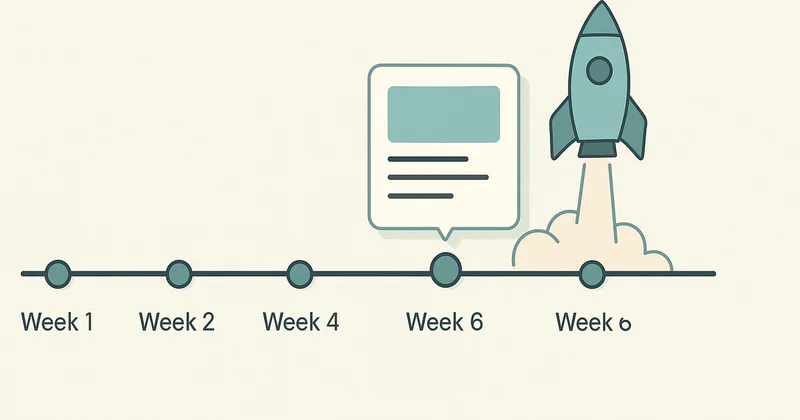
I have read more than thirty SaaS product launch templates over the last four years. Most of them are wrong about the same thing. They schedule the demo for after launch — week 12, week 14, "as part of post-launch enablement" — when it should be live the day the announcement ships. That single sequencing error is why most SaaS launches feel hollow. The press post goes out, the homepage banner flips, the email lands in inboxes — and the buyer who wants to actually see the thing has nothing to click. They get a 90-second product video, a static screenshot grid, and a "request a demo" button that routes them into a sales funnel they did not ask to enter.
That is my defended thesis for this entire post: the launch demo asset is the most important deliverable in a product launch sequence, and it has to ship at week 6, not week 12. A launch without a launch demo is words. A launch with one is evaluation-ready. Everything else in this template — positioning, messaging, distribution, monitoring — is built around protecting the timing of that one asset.
This template is the structured 60-90 day plan I now hand to PMM teams running launches on SmartCue. It assumes a SaaS feature or product launch with a buyer who needs to evaluate before they buy. If your launch is a marketing campaign for a feature buyers will discover passively, you need a different template. If your launch is a meaningful product moment that pipeline targets and renewals depend on, this is the one.
What the typical product launch template misses
Most launch templates I have seen are built around the press moment. The deliverables list reads: positioning brief, messaging house, press release, blog post, social posts, email announcement, sales enablement deck, FAQ, internal wiki page. The launch demo, when it appears at all, lives in the "post-launch enablement" section. Week 12. Week 14. After the launch announcement has already gone cold.
Three problems with that ordering.
The first problem is buyer behavior. When a launch announcement crosses a buyer's desk, the question they ask is not "do I believe this exists." The question is "do I believe this works for me." The press post does not answer that. The static screenshots do not answer it. A pre-recorded product video does not really answer it either, because video is one-directional and the buyer cannot navigate to the part they care about. The thing that answers it is an interactive demo where the buyer clicks through the actual surface, in the actual flow, with the actual data shape they care about. If that asset is not live the day the announcement ships, the announcement asks the buyer to be patient. Buyers, in 2026, are not patient.
The second problem is sales enablement. A launch without a launch demo means the AE team gets a deck and a talk track. The deck is theater. AEs cannot send a deck to a curious prospect and expect a reply. They can send an interactive demo link. They cannot. So they default to "let me schedule a 30-minute call" — which is the friction the launch was supposed to remove. The launch generates pipeline only if the demo asset is in AE hands at week 6, not week 12.
The third problem is data. A launch that ships without a demo asset has no high-signal engagement metric. Email opens and press coverage are vanity. Demo views, completion rate, step-level drop-off, CTA click rate — those are the signals that tell PMM whether the messaging actually landed and which persona segment is converting. Skipping the demo asset means launching blind for the first six weeks, which is exactly the period when the messaging is most malleable and the signal would be most useful.
The template below puts demo-creation at week 6 because by then positioning, messaging, and the persona variants are stable enough to capture against. Earlier than that and the demo gets re-shot. Later than that and the launch ships with a hole in it.
The demo-first launch sequence
The structure is twelve weeks. Weeks 1-4 are positioning and messaging. Weeks 5-6 are the launch demo build. Weeks 7-8 are distribution channels and rehearsal. Weeks 9-10 are launch and monitoring. Weeks 11-12 are iteration and repurposing into the longer content tail.
Each phase has a single owner. PMM leads weeks 1-6. PMM and growth co-own weeks 7-8. The full GTM team owns weeks 9-12. If you do not have a PMM, the role belongs to whoever owns positioning — usually the founder, sometimes the head of marketing. The role label does not matter. The clarity of ownership does.
I have watched this sequence play out at Personify Health, Creditsafe, OneDigital, League, Quisitive, Dario Health, and at the smaller end across thousands of teams on SmartCue. The launches that move pipeline ship the demo at week 6. The launches that do not, do not.
Week 1-2: positioning and audience
The first two weeks are not creative work. They are research and judgment. The output is a one-page positioning document and a ranked audience list. Neither is allowed to be longer than one page.
The positioning document answers four questions. What is this thing. Who is it for. What does it replace or compete with. Why does it win. Each answer is one paragraph. If the positioning team needs three paragraphs to say what the thing is, the thing is not yet ready to launch — go back to product and refine scope.
The audience list ranks the buyer personas and the channels they live on. For most B2B SaaS launches the list has three personas at most: the economic buyer, the technical evaluator, and the end user. Rank them. The launch demo will need a variant per persona, which means the list size has direct downstream cost — five personas means five variants means a slower week 5-6.
The audience list also includes channel weighting. Where does each persona discover the launch — newsletter, LinkedIn, podcast appearance, email list, partner channel, paid. Weighting matters because distribution work in week 7-8 will get cut to fit the calendar; knowing which channel cannot be cut prevents the wrong cuts.
By end of week 2, positioning and audience are signed off by the GTM lead. No edits accepted after sign-off without an explicit re-open.
Week 3-4: messaging and draft
Weeks 3 and 4 turn positioning into the actual words that ship. The deliverables are the launch announcement copy (blog post, email, social, press release if applicable), the sales talk track, the FAQ, and — most importantly — the demo script.
The demo script is the deliverable most launch templates underweight. It is not a transcript. It is the ordered list of screens the launch demo will walk through, the captions on each step, the persona-variant points where the script forks, and the CTA placement. The script is what the demo capture in week 5-6 is built against. Without it, week 5-6 becomes improvisation, which means the demo gets re-shot, which means it ships at week 8 not week 6.
I write demo scripts in the same one-page format as positioning. Eight to fifteen steps. Two to three captions per persona variant. One CTA per variant. The skill is restraint. A 30-step demo script always becomes a 30-step demo and a 30-step demo always has a completion rate below 20%. About 12 steps is the median across SmartCue's customer base for a reason.
By end of week 4, the announcement copy is in review, the FAQ is drafted, the demo script is signed off, and the persona variants are explicit. Week 5 starts with capture, not with re-discussing scope.
Week 5-6: launch demo build and persona variants
Week 5 is capture. Week 6 is variant production and review.
Capture happens in one to two sessions of 90 minutes each. The PMM (or whoever owns the demo script) installs the SmartCue Chrome extension, walks through the product surface following the demo script, and captures the source flow. Median capture takes about 90 minutes for the first attempt, about 45 minutes by the third. The first capture is rarely the one that ships — most teams re-shoot one or two steps after reviewing the source flow against the script.
Week 6 is where the launch-demo-first thesis lives or dies. By the end of week 6 the demo is published, the persona variants are produced, the captions are localized to each persona, the CTAs are wired up, the lead-capture form is configured, and the analytics tags are set so that demo views can be attributed back to the channel that drove them.
A persona variant is not a separate demo from scratch. It is the same source capture with persona-specific captions, a persona-specific intro screen, and a persona-specific CTA. Three persona variants take about three hours of additional production time on top of the source demo. That is a small price for the conversion lift you get from sending the technical evaluator a technical-evaluator-targeted demo instead of the generic one.
Embed code is generated at the end of week 6. The demo lives at a stable URL. The marketing site team, the AE team, and the partner team can all begin pre-loading the embed into their week 9-10 surfaces. This is the moment the launch becomes evaluation-ready.
Week 7-8: distribution channels
With the demo asset stable and the announcement copy in review, weeks 7-8 are distribution. The work splits across owned, earned, and partner channels.
Owned channels are the easiest. Homepage hero embed of the launch demo. Dedicated landing page with the demo embedded above the fold. Email to the existing list with the demo link in the second paragraph, not buried at the bottom. In-app banner pointing existing users to the new feature with the demo as the explainer.
Earned channels need lead time. Press outreach starts at week 7 with a one-paragraph pitch and the demo link. Reporters who can click through the demo write better coverage than reporters who cannot. Influencer outreach — relevant LinkedIn voices, podcast hosts, newsletter authors — happens in parallel. Each gets a personalized note and the demo link.
Partner channels are usually the most underused. If the launch has integration partners, co-marketing partners, or category-adjacent partners, week 7-8 is when their teams get the embed code, the announcement copy, and a co-branded landing page if applicable. Partner-driven launches frequently outperform owned-channel launches at SaaS companies under 200 employees because the partner's audience is already qualified.
By end of week 8, every channel has the demo link, the announcement copy is final, the AE team has talk-track training, and the launch day calendar is locked.
Week 9-10: launch and monitor
Launch day is week 9, day 1. Everything ships in a coordinated wave: blog post, email, social posts, press release, partner posts, in-app banner, paid campaigns flip on. The launch demo is the asset every channel points to.
Monitoring starts the same hour. The metrics to watch in the first 72 hours are demo views by source, demo completion rate, step-level drop-off, CTA click rate, and lead-capture rate. Email opens and press coverage are vanity for this launch — useful for the press team's quarterly report, useless for live optimization.
The patterns I have watched across launches. If completion rate is below 20%, the demo is too long — cut steps in week 11. If a specific step has 40%+ drop-off, the script forked too early or the caption is unclear — re-caption in week 11. If CTA click rate is below 4%, the CTA copy is the problem, not the demo. If lead-capture rate is below 1%, the gate is placed too early — move it later in the flow.
Weeks 9 and 10 are not the time to make the big edits. Capture the data, ship small fixes (caption tweaks, CTA copy A/B), let the launch breathe. The big iteration is week 11.
Week 11-12: iterate and repurpose
By week 11, two weeks of data are in. Iteration happens in three dimensions.
Demo iteration. Re-cut the steps that bled viewers. Re-write the CTAs that did not convert. Add a fourth persona variant if the launch surfaced a buyer segment the original audience list missed. Most launches generate one or two unexpected segments — the variant production cycle in week 11 is where they get served.
Messaging iteration. The data tells PMM which messaging hooks landed. Update the homepage copy, the email templates the AE team uses, and the FAQ to lean into the messaging that worked.
Repurposing. The launch demo becomes the source asset for a long content tail. Week 12 is when the demo gets sliced into clips for LinkedIn and X, captioned for podcast cross-posts, embedded into review-site listings, dropped into G2 / Capterra profile pages, and routed into the SDR cold-email sequence as the lead-magnet asset. A launch demo that is only used during the launch week is a launch demo that wastes 80% of its value.
By end of week 12, the launch is complete, the demo is live in 6-10 places, the data has informed the next quarter's messaging, and the AE team is sending the demo link as the standard reply to "tell me more about the new feature."
Customer marquee — the launch-demo workflow at scale

The clearest example of this template running in production lives at Personify Health (formerly Virgin Pulse), the global digital health platform with about 3,000 employees. Their PMM team treats every meaningful product moment as a launch with an interactive demo as the launch artifact. Across the program they have shipped 800+ interactive demos and well over 100,000 viewer interactions. Each launch follows a version of the week 1-12 sequence above, with the demo asset live the day the announcement ships and the persona variants produced before the launch wave hits.
What they get out of it: AEs send the launch-demo link as the first reply to inbound interest. Marketing routes the demo into ABM sequences. CS uses the demo as the explainer for existing customers adopting the new feature. The demo asset is the unifying artifact across PMM, sales, and CS — which is exactly what the buyer wanted in the first place.
Creditsafe, the global credit-data platform with 1,500+ employees, runs a similar template at regional scale: a launch demo gets produced once at the global level, and regional PMM leads localize the captions and CTAs without re-capturing. They have shipped 1,000+ demos and 30,000+ viewer interactions. The federation model only works because the launch-demo-first sequencing is the same across regions — variants happen at the caption layer, not the script layer.
OneDigital, US benefits services, 3,000+ employees, runs a sales-led variation: the launch demo is built jointly by PMM and sales, and AEs personalize the variants for individual outbound. They have 250+ active demos.
League, Quisitive, Dario Health — variants of the same operating model at different sizes.
The unifying signal across all of them: the launch demo ships at week 6, not week 12. None of them tried to schedule the demo for post-launch and then realized the launch had a hole in it. They all started with the demo at the center.

Frequently asked about product launch templates
Why does the launch demo have to ship at week 6 instead of week 8 or 9?
Because weeks 7-8 are when distribution channels need a stable demo URL to embed. If the demo is still in production, the press team is pitching without an asset, the email designer is laying out an announcement around a placeholder, and the AE team is rehearsing a talk track without the asset. Each downstream team's week 7-8 work is gated on the demo URL existing. Week 6 is the latest the demo can go live without cascading delays into the launch wave.
What if my launch is smaller — a feature update, not a product launch?
Compress the template, do not skip the demo. A feature update can run on a 6-week version of this sequence: weeks 1-2 positioning and demo script (combined), week 3 capture, week 4 variant production, week 5 distribution prep, week 6 launch and monitor. The demo still ships before the announcement.
How many persona variants do I actually need?
Two to three for most launches. One for the economic buyer (focused on outcome and ROI), one for the technical evaluator (focused on integration and surface area), one for the end user (focused on day-to-day workflow). Five variants is too many — production cost compounds and most launches do not have enough audience volume to justify the segmentation.
What about CRM integration for the launch demo?
For HubSpot users: SmartCue syncs lead-capture data directly into HubSpot, so demo viewers attach to existing contact records and the launch's pipeline impact is visible in the same dashboards the AE team already uses. For other CRMs, the integration story varies — verify with your platform vendor before week 6.
Do I need a dedicated PMM to run this template?
No. The PMM role can be filled by whoever owns positioning. At smaller companies that is usually the founder. At mid-size companies it is usually the head of marketing or a senior product marketer. The role label does not matter. What matters is that one person owns the positioning, the demo script, and the launch-day decision authority — and that they are not also doing capture and variant production, which need a different headspace.
How do I measure whether the launch worked?
The metrics that matter, in order: demo views attributable to launch channels, demo completion rate, CTA click rate, lead-capture rate, pipeline-influenced revenue at the 90-day mark. Email opens and press coverage are useful for the comms team's report; they are not the launch's success metric.
What if my product is enterprise and the buyer cannot self-serve evaluate?
The launch demo is even more important. An enterprise buyer who has to schedule a call to see the product will deprioritize the call when their week is busy. An enterprise buyer who can click through a demo at 9pm from their phone, on the day the announcement landed, gets to "I want this for my team" before the call is even scheduled. The demo does not replace the sales conversation — it qualifies the buyer before the sales conversation, which makes the sales conversation faster and more productive.
What is the failure mode this template still leaves on the table?
Production capacity in week 5-6. If the PMM team is also running the rest of the launch — copy review, AE training, FAQ writing — capture and variant production gets squeezed. The fix is either dedicating one person to demo production for those two weeks or starting the demo script earlier so that capture in week 5 takes 60 minutes instead of 90. The launches I have seen miss the week 6 demo deadline almost always missed it because week 5-6 was treated as a side project, not a primary deliverable.
Related reading
- Why SaaS Product Marketers Love SmartCue for Demo Personalization — the PMM workflow this template plugs into
- Demo Automation Playbook — the 90-day rollout template that operationalizes ongoing demo production
- 12 Interactive Product Demo Examples — finished launch demos to reference
- Sales Personalization at Scale — how AEs use the launch demo asset post-launch
- What Is SmartCue? — the platform behind this template
Run the launch-demo-first template on your next product launch — sign up free at app.getsmartcue.com. Or see pricing →.