By Robin Singhvi · Founder, SmartCue · Updated April 29, 2026
Most posts about demo automation are written for marketers. They talk about website hero embeds, gated content for demand gen, and PLG funnels. That framing is fine — for marketers. It is also why most sales orgs that buy a demo automation platform get nothing out of it. They are reading the marketer's instructions and trying to run a sales motion off them.
Sales demo automation is its own workflow. It shares tools with marketing demo automation — same capture, same editor, same analytics layer — but the buyer, the channel, the personalization unit, and the metric of success are all different. If you are an AE, a sales manager, or a sales ops lead reading a generic demo automation post and quietly thinking "this doesn't quite map to my world," you are correct. It doesn't. Let me write the version that does.
I built SmartCue. About 4,000+ teams run on it today, and a meaningful chunk of them — Personify Health, Creditsafe, OneDigital, League, Quisitive, Dario Health among the named ones — use it primarily for sales motions, not marketing motions. The patterns below come from watching what those sales orgs actually do in the product, what they measure, and where they break.
The defended thesis
Sales demo automation is a different workflow from marketing demo automation, even though they share the same tools. Marketing automation is "build once, distribute via owned channels, measure at top-of-funnel." Sales automation is "personalize per prospect, send via cold or warm outreach, measure against deal velocity." Most teams treat them as one workflow and end up serving neither buyer well — the marketing demos are too generic to land in a cold email, and the sales demos are too one-off to support pipeline at scale.
The fix is not a new tool. The fix is recognizing they are two workflows on the same platform, with two different owners, two different cadences, and two different scoreboards. Once you accept that, the rest of this post is operational.
What sales demo automation is, specifically
Sales demo automation is the workflow that lets an AE — or sales ops on behalf of AEs — produce a personalized interactive demo for a specific prospect or prospect segment, deliver it through a sales channel (cold email, warm follow-up, leave-behind, late-stage proof), and tie the resulting buyer behavior back to deal velocity inside a CRM.
Three things make this different from marketing demo automation:
The unit of personalization is a prospect or a small named segment, not a persona. A marketing demo is built for "VP of Operations at mid-market healthcare." A sales demo is built for "Sarah Chen, VP Ops at Memorial Health, who told me on the discovery call that her board cares about audit readiness." The level of resolution is different by an order of magnitude.
The distribution channel is outbound and one-to-one, not owned and one-to-many. Marketing demos live on the website, in paid landing pages, and in nurture emails. Sales demos live in cold sequences, warm follow-ups, calendar invites, and deal-stage leave-behinds. The buyer reaches the marketing demo via search; the buyer reaches the sales demo because an AE put it directly in front of them.
The measurement frame is deal velocity, not lead generation. A marketing demo is good if it generates a qualified lead. A sales demo is good if it shortens the cycle from discovery to close, lifts the meeting acceptance rate from cold, or tips a stalled late-stage deal back into motion. Pipeline created is the marketer's metric. Pipeline closed faster is the sales metric.
When a team treats these as the same workflow, the demos end up neither generic enough to scale on a website nor specific enough to land in a cold email. They occupy a kind of middle ground that doesn't serve either buyer.
The sales workflow phases — same names, sales-specific lens
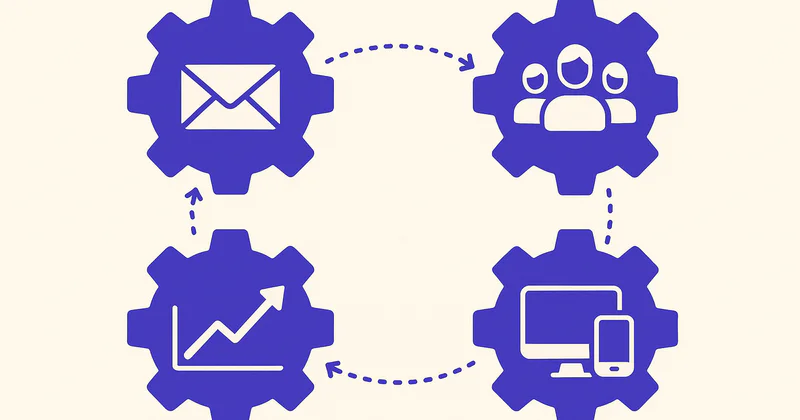
The four phases of demo automation — capture, personalize, distribute, measure — are universal. The way each phase actually runs in a sales motion is not the same as in a marketing motion.
Capture (sales lens)
In marketing demo automation, capture is centralized. PMM records a master flow once, and that flow becomes the spine of every variant. The investment per capture is high; the reuse rate is high.
In sales demo automation, capture is modular. AEs need a library of pre-recorded demo blocks — a "fraud detection module," a "user provisioning module," a "reporting module" — that they can mix and match per prospect, plus a Chrome extension that lets them record a fresh ad-hoc segment in 15 minutes if a discovery call surfaces something specific. The investment per block is low; the reuse rate per block is high across AEs.
The mistake sales orgs make at capture: they ask PMM to build their demos. PMM builds one or two beautiful comprehensive demos that cover the whole product, then AEs ignore them because they are too long and too generic to send to a specific prospect. The fix is a sales enablement library of short modules — about 12 steps each, roughly 6 minutes — that an AE can stitch into a 4-block sequence for a specific deal in under 10 minutes.
Personalize (sales lens)
Marketing personalization is persona-by-segment. Director of Marketing sees one variant, VP of Sales Ops sees another. The variants are pre-built; the buyer self-selects via the channel they came through.
Sales personalization is per-prospect. The AE drops the prospect's company name into the title slide, picks the three modules most relevant to what they heard on the discovery call, adds a short captioned intro from the AE on step 1, and sends. The variant is single-use. It is built in minutes, not hours.
The mistake sales orgs make at personalization: they over-invest. A 30-minute personalization on a single prospect is not the workflow. The workflow is a 5-minute personalization that lifts the reply rate from a cold sequence by enough to be worth the 5 minutes. If you are spending 30 minutes per personalized demo, the workflow is broken — either your library is wrong, your editor is too clunky, or you are personalizing prospects who don't deserve it.
Distribute (sales lens)
Marketing distribution is placement. The demo lives on the website hero, the pricing page, the landing page for a specific campaign. The buyer comes to the demo.
Sales distribution is outreach. The demo goes out via cold email, LinkedIn DM, follow-up email after a discovery call, calendar invite description ahead of a deeper meeting, or as a leave-behind link sent in the recap email after a call. The demo goes to the buyer.
The four sales-specific channels worth getting right:
Cold outreach. A short personalized demo embedded as a tracked link in a cold sequence. Not as the main pitch — as the proof that the AE understood the prospect's world enough to record something specific. Reply-rate uplift is the test.
Warm follow-up. After a discovery call, the AE sends a recap email with a personalized demo that reflects the three things the prospect said mattered most. Meeting acceptance rate to the next step is the test.
Discovery leave-behind. A demo link the AE sends as the meeting recap so the prospect can re-watch the relevant moments at their own pace and forward to a colleague. Internal-share rate (how often the link gets viewed by a second IP within the same company domain) is the test.
Late-stage proof. When a deal stalls in legal or procurement, the AE sends a demo that addresses the specific objection — security walkthrough, integration walkthrough, admin-controls walkthrough — to keep the deal warm. Stalled-deal recovery rate is the test.
Each of those channels needs a slightly different demo shape. Cold outreach demos are short, 4-6 steps. Late-stage demos are longer, can run 15-20 steps because the prospect is already invested. The workflow respects the channel.
Measure (sales lens)
Marketing measurement stops at lead generation. Form-fills, MQLs, demo requests booked.
Sales measurement starts there and runs through the deal. The four metrics that matter for sales demo automation, in the order they show up in the funnel:
Reply rate uplift on cold sequences with a personalized demo vs. without. If a personalized demo doesn't lift reply rate by a meaningful margin, the personalization isn't working — or the prospects are wrong.
Meeting conversion rate from cold to discovery call. Did the prospect actually book the next meeting after watching the demo? This is where the demo earns its keep at the top of the sales funnel.
Opportunity creation rate. Of the discovery calls the demo influenced, how many converted to a real qualified opportunity in the CRM? This separates "demos that book meetings" from "demos that move deals."
Win rate uplift on demo-touched deals vs. demo-untouched deals. The end-of-funnel test. Holding for noise (deal size, segment, AE), do deals where the prospect engaged with a personalized demo close at a higher rate? This is the metric the CRO cares about, and it is the only one that justifies the program in a renewal review.
Sales orgs that only measure reply rates and meetings are stuck at the same place marketing orgs are. The win-rate measurement is what makes this a sales program rather than a sales-shaped marketing program.
The sales-specific channels in more depth
Cold outreach is the use case sales orgs underinvest in. The pattern that works: a 5-step personalized demo, embedded as a tracked link in the third or fourth touch of a cold sequence. The first three touches are text. The fourth touch is "I recorded a 90-second walkthrough of how [your competitor or peer] uses our fraud-flagging module — three minutes, no calendar invite." The demo's job is to demonstrate effort and specificity, not to sell the whole product. AE replies meaningfully when the demo proves the AE has done their homework.
Warm follow-up after a discovery call is where most sales orgs already use video — Loom, Vidyard, BombBomb. Replacing the Loom with an interactive demo gives the prospect something they can re-watch in chunks, share with a colleague, and revisit before the next meeting. The Loom is linear; the demo is navigable. That single shift — from linear to navigable — typically shows up as a meaningful lift in next-meeting acceptance rate, because the prospect can hand the demo to the procurement person without forwarding a 12-minute video.
Discovery leave-behinds are the highest-ROI sales channel and the one most teams ignore. The setup: at the end of a discovery call, the AE drops a demo link into the recap email. The demo's first three steps are a 60-second recap of "what we heard you say matters." The next 6-8 steps are the product responses to those points. The last step is a CTA to book the next meeting. Internal-share signals (the same demo viewed twice from the same email domain on different days) is the leading indicator that the deal will progress.
Late-stage proof is the channel that surprises sales managers when they look at the data. Stalled deals in legal review or procurement queue often die quietly. A targeted demo — security architecture walkthrough, integrations walkthrough, admin-controls walkthrough — sent at the right moment in the stall keeps the deal warm because it gives the internal champion something concrete to show their stakeholders. The metric here is recovery rate of stalled deals, which is hard to measure cleanly but easy to feel: AEs notice the difference within a quarter.

Who owns what in a sales demo automation program
Sales demo automation breaks the most common org chart for demos, where PMM owns the program and sales is a downstream consumer. In a real sales motion, the ownership has to be inside the sales org or the program dies of priority mismatch.
The split that works:
AE owns capture and personalization at the deal level. Each AE is responsible for the demos that go into their own deals. Five minutes per personalization, no exceptions. If the AE doesn't own this, the personalization investment becomes a sales ops bottleneck and the program slows to nothing.
Sales enablement owns the module library. The reusable blocks — the fraud-flagging module, the user-provisioning module, the integrations module — are sales enablement's responsibility. They get rebuilt when the product UI changes, and they get pruned when usage analytics show a module nobody uses. Sales enablement also owns AE training on the tool: every new AE should be able to ship their first personalized demo within their first week.
Sales ops owns measurement. The reply-rate dashboard, the meeting-conversion dashboard, the win-rate-by-demo-touch dashboard. Sales ops sets the experimentation framework — A/B tests on personalization depth, on send timing, on demo length — and reports the win rate uplift to the CRO quarterly.
The CRO owns the outcome. The program lives or dies based on win-rate uplift. If sales ops can't show a win-rate lift after two quarters, the program either pivots or shuts down. No vanity-metric refuge.
This is the ownership structure I see consistently at the SmartCue customers running sales-led motions. When a sales demo program is owned by marketing, it stalls. When it is owned by sales enablement reporting into the CRO, it compounds.
Common sales-side anti-patterns
A short list of the failure modes I have watched recur across the customer base.
Treating sales demos as marketing demos with a sales sticker. PMM builds a comprehensive 20-minute demo for the marketing site. Sales is told "use this for outreach too." AEs send it twice, get nothing back, stop using it. The demo was the wrong shape for the channel.
Personalizing too deep. AE spends 45 minutes on a custom demo for one prospect. Reply rate may go up, but the AE only ships two demos a week. The math doesn't work. Personalization budget per demo is 5-10 minutes, and the workflow has to make that possible.
Personalizing too shallow. AE drops the prospect's logo on the title slide and calls it personalized. Buyers see through this in seconds. Real personalization is about content choice, not visual chrome.
Measuring reach instead of velocity. "We hit 10,000 demo views this quarter" is not a sales metric. It is a marketing metric the sales org accidentally adopted. The sales metric is win-rate lift on demo-touched deals.
Letting the module library go stale. The product ships a UI change. The sales enablement team forgets to update three modules. Six months later, AEs are sending demos that show the old UI. Buyers notice. Trust gets dented. There has to be a refresh cadence tied to product release notes.
Building a sales demo workflow without CRM tie-in. If demo engagement isn't visible inside the CRM next to the deal record, sales managers can't make decisions on it. HubSpot tie-in is non-negotiable for SmartCue customers running sales motions for this reason.
Where SmartCue customers run this in practice
OneDigital — the US benefits services company at roughly 3,000 employees — is the cleanest example I see in the customer base of a sales-led demo automation program. Their AEs run 250+ active demos at any given time, with sales ops owning the measurement layer and sales enablement owning the module library. The ownership pattern is the one I described above. The win-rate evidence is internal to them; what I see externally is sustained year-over-year usage and an active deployment that has expanded over time.
Personify Health — the global digital health platform at around 3,000 employees, formerly Virgin Pulse — runs 800+ interactive demos with well over 100,000 viewer interactions. Their pattern is mixed: PMM owns the marketing-side demos, but the sales side runs its own personalized variants for HR-buyer audiences and broker audiences. The two sides share a common module library but operate as two distinct workflows, which is exactly the structure this post argues for.
Creditsafe — the global credit-data company — runs 1,000+ demos across regional sub-orgs. Each region's sales team operates demos in its own market, sharing the central capture library but personalizing for local buyer language. League, Quisitive, and Dario Health run variants of the same pattern at different scales.
The common thread across all of them: someone explicitly named the sales workflow as different from the marketing workflow, before any tool was bought. They didn't discover that distinction by using SmartCue; they figured it out, then chose SmartCue.

What to look for in a platform if sales is the primary workflow
If your demo automation program is sales-led from day one, the platform criteria shift:
A short list of capabilities that matter more for sales than for marketing — fast per-prospect personalization in under 10 minutes, modular libraries that AEs can stitch on the fly, HubSpot lead and engagement sync so the demo activity shows up next to the deal record, per-step analytics granular enough to measure drop-off inside a single demo, share-link tracking that distinguishes between the original prospect and forwarded views, and a Chrome extension capture flow that an AE can use without sales ops in the loop.
SmartCue runs on production-grade cloud infrastructure with TLS 1.2+ in transit and AES-256 at rest. HubSpot is the supported CRM for lead sync — one CRM, done well, beats five integrated badly. Beyond HubSpot, distribution works anywhere that supports HTML embed. Plans start at $99/user/year for self-serve and $300/user/year for team plans. Security details live on /security.
I built SmartCue. So when I say it fits sales workflows well, that is a vendor-of-record opinion. The honest take that does not depend on which platform you pick: every criterion above applies whether you choose SmartCue, Walnut, Supademo, Storylane, Navattic, or anyone else. Use the criteria to evaluate the platform you are considering. If a vendor pitches you a "demo automation platform" and can't articulate how their tool serves sales differently from marketing, that is a signal.
Frequently asked about sales demo automation
Is sales demo automation different from marketing demo automation?
Yes — same platform, different workflows. Marketing demo automation is "build once, distribute via owned channels, measure at top-of-funnel." Sales demo automation is "personalize per prospect, send via outbound or warm outreach, measure against deal velocity." The buyer, the channel, and the success metric are all different. Most teams that fail at demo automation conflated the two workflows.
Who owns sales demo automation in a typical sales org?
AEs own per-deal capture and personalization. Sales enablement owns the reusable module library and AE training. Sales ops owns the measurement layer and the experimentation framework. The CRO owns the outcome — specifically, the win-rate lift on demo-touched deals. When marketing owns sales demo automation, the program stalls; when sales enablement owns it reporting into the CRO, it compounds.
How long should sales personalization take per prospect?
About 5-10 minutes per demo, not 30. If your AEs are spending 30 minutes on a single personalization, either the module library is wrong, the editor is too clunky, or the prospects being personalized for don't deserve that level of investment. Real personalization is about content choice — which modules and which captions — not visual chrome.
Which sales channels benefit most from interactive demos?
Four channels matter: cold outreach (lifts reply rate when sent at touch 3 or 4 of a sequence), warm follow-up after discovery calls (lifts next-meeting acceptance rate), discovery leave-behinds (drives internal-share inside the prospect company), and late-stage proof on stalled deals (recovers deals stuck in legal or procurement). Each channel needs a slightly different demo shape — cold demos are short, late-stage demos can run longer.
What metrics actually matter for sales demo automation?
Four, in funnel order: reply rate uplift on cold sequences, meeting conversion rate to discovery, opportunity creation rate, and win rate uplift on demo-touched deals vs. untouched. The last one is the only metric that justifies the program in a renewal review. If you only measure reach and engagement, you have a sales-shaped marketing program, not a sales program.
How does sales demo automation tie into a CRM?
Demo engagement signals — opens, completion, time-on-step, lead-form completion — should land in the CRM next to the deal record so sales managers can make decisions. SmartCue syncs to HubSpot natively. For other CRMs, the standard fallback is HubSpot as the system of engagement plus whatever your system of record is downstream. Without CRM tie-in, you can't measure win-rate lift, and the program loses its budget defense.
Do AEs actually adopt this, or does the tool sit unused?
Adoption depends on three things: a module library AEs can use without sales ops in the loop, a per-prospect personalization workflow that takes under 10 minutes, and a manager scoreboard that makes demo-touched deals visible. When all three are present, AE adoption holds. When any one is missing, the tool sits unused within a quarter. OneDigital's 250+ active demos is the kind of footprint that signals real adoption rather than seat sprawl.
Is sales demo automation worth it for small sales teams?
Below five AEs, the math is more about per-AE productivity than about program ROI. A solo AE shipping 8-12 personalized demos a month into a 50-touch outbound cadence will see reply-rate lift fast enough to justify the seat cost. The full sprint structure — AE, sales enablement, sales ops, CRO ownership — is overkill at that scale. Above 20 AEs, the program structure starts to matter because the consistency problem gets real.
Related reading
- What is demo automation? — the workflow framing this post extends
- Demo Automation Playbook — the 90-day rollout sequence
- Interactive product demo examples — what good demos look like across the funnel
- How to create an interactive product demo — the capture walkthrough
- What is SmartCue? — the product behind this post
Build your first sales-shaped demo in 6 minutes — no sales call, no credit card, no waiting on me. Start free → or see pricing →.