By Robin Singhvi · Founder, SmartCue · Updated April 29, 2026
This is the operational playbook for rolling out demo automation in 90 days. It assumes you've already read What Is Demo Automation? and bought into the workflow-first reframe. If you haven't, start there. This post is the build instructions; that post is the architecture.
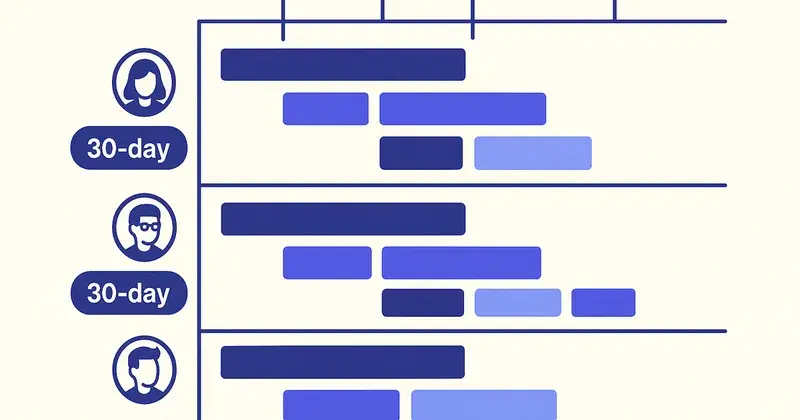
The playbook is organized as three 30-day sprints. Each sprint has explicit role assignments, deliverables, and exit criteria. Skip a sprint and the workflow breaks. Skip a role assignment and the workflow has no owner. Skip the exit criteria and you can't tell whether what you shipped works.
I've watched this rollout play out across 4,000+ teams on SmartCue. The teams that follow a sprint structure like this one — Personify Health (formerly Virgin Pulse), Creditsafe, OneDigital, League, Quisitive, Dario Health, and thousands of smaller teams — produce demo automation programs that compound. The teams that buy a tool and try to figure it out on the fly are the ones still asking what their demo automation strategy is twelve months later.
Before Day 0: the four prerequisites
Don't start the rollout without these four things in place. Each one prevents a specific failure mode that kills demo automation programs in month 6.
Prerequisite 1 — A named GTM lead. One person who owns the program at the strategy level. Title doesn't matter — VP of Marketing, Head of Product, RevOps lead, founder. Authority matters: this person can call the cross-functional meeting and make a decision in it. If three people each "kind of own" demo automation, nobody owns it.
Prerequisite 2 — A target pipeline metric. One number that demo automation will be measured against in the renewal review. Example metrics: "lift in demo→opportunity conversion rate by Q3," "trial-start rate from cold-email outreach by Q2," "completed onboarding tasks before kickoff call by Q4." Without a target metric, you'll measure vanity numbers and lose the program in the next budget cycle.
Prerequisite 3 — A platform decision. SmartCue, Walnut, Navattic, Storylane, Supademo, Reprise, Arcade — pick one. The platform doesn't matter as much as picking it. Switching platforms mid-rollout adds three months. Comparison roundup at /lp/smartcue-alternatives if you haven't picked yet.
Prerequisite 4 — Stakeholder alignment. PMM, sales, CS, and product leads agree the program is happening. Even if they're not actively contributing in Sprint 1, they know the playbook exists and that demos in their funnel area will be coming. Surprises kill programs.
If any of those four is missing, fix that first. The rollout below assumes all four are in place.
Sprint 1 (Days 1-30): Pilot
Goal: ship one production-grade interactive demo end-to-end through all four workflow phases. Use real audience, real distribution, real measurement. No production demos at scale yet.
Owner: the GTM lead, with hands-on contribution from one PMM (or whoever will own capture going forward).
Week 1 — Workflow design
Output: a one-page document with five sections.
- Audiences. List the buyer personas the demo program will serve. Sprint 1 picks one — the highest-priority persona for your current pipeline.
- Capture ownership. Who records the source demo? Default: PMM for marketing-led demos, AE for sales-led demos.
- Personalization plan. What variants does this demo need? Sprint 1 picks at most one variant axis — usually persona OR funnel stage, not both.
- Distribution plan. Where does this demo go live? Sprint 1 picks one channel — usually the website hero embed or a sales follow-up email sequence.
- Measurement plan. Which pipeline metric does this demo move? How will you measure it? At what cadence?
This document goes into the team's shared docs space. Nobody starts capture in week 2 without it being signed off.
Week 2 — Capture and edit
PMM or designated capturer installs the platform's Chrome extension and walks through the chosen flow. The first capture attempt usually takes 90 minutes — most of that figuring out the editor, not the actual product walkthrough.
Edit pass: reorder steps if the captured flow doesn't match the intended narrative, add captions, drop in highlights at key moments, set the AI voiceover voice if applicable. Median demo on the SmartCue platform has about 12 steps; aim for 8-15 for the pilot.
Week 3 — Distribute
Embed the demo on the chosen distribution surface. Website embed: drop the snippet on the homepage hero or use the lead-gated landing page format. Sales email: paste the share link into the email template the sales team uses for outbound or follow-up.
Tag the demo in the platform's analytics so you can attribute viewer engagement to the distribution surface.
Week 4 — First measurement check-in
Pull the engagement data from the platform: views, completion rate, step-level drop-off, CTA clicks, lead-gate completions. Cross-reference with the pipeline metric defined in Week 1.
Sprint 1 exit criteria — all three must be true:
- Demo is published and embedded on the chosen surface
- Demo has measurable viewer activity (not zero — even single-digit views is fine in week 4)
- Pipeline-metric measurement framework is wired up, even if the metric hasn't moved yet
If any of those three fails, Sprint 1 extends another two weeks. Don't move to Sprint 2 with a half-built pilot.
Sprint 2 (Days 31-60): Scale to the working channel
Goal: ship 5-10 demos on the same channel + persona that worked in Sprint 1. Tune the workflow based on what Sprint 1 surfaced. Don't add new channels yet.
Owner: still the GTM lead, with PMM (or sales lead, depending on chosen channel) doing the bulk of the production work.

Days 31-40 — Production cadence
Build 5-10 additional demos on the same workflow Sprint 1 validated. Same persona, same channel. The point is to lock in production muscle memory before adding complexity.
If Sprint 1's pilot took 6 hours of hands-on time, Sprint 2's average should land at 60-90 minutes per demo by demo number 5. If it doesn't, the workflow has a bottleneck that needs fixing — usually capture quality or step-organization decisions made too late in the editor.
Days 41-50 — Measurement maturity
By Day 41 you have 5-10 demos shipped with measurable engagement. Now the metrics framework gets serious:
- Reach metrics — demo opens by source (which sales email template? which landing page? which paid campaign?)
- Engagement metrics — completion rate, median time-on-demo, step-level drop-off (which steps lose viewers?)
- Action metrics — CTA clicks, lead-capture form completions, calendar bookings
- Revenue-proxy metrics — meeting conversion rate after demo touch, trial-start rate after demo touch
Build a one-screen dashboard that shows all four metric levels for the demos shipped in Sprints 1 and 2. The dashboard goes into the GTM lead's regular weekly review.
Days 51-60 — Workflow tuning
Use the measurement data to tune the workflow:
- If completion rate is low, demos are too long — cut steps
- If step-level drop-off concentrates at one step, that step needs reordering or a clearer caption
- If CTA click rate is low, the CTA copy or placement is off — A/B test
- If lead-gate completion rate is low, the gate is too early or the value-exchange is unclear
- If revenue-proxy metrics aren't moving, audience-targeting (not demo quality) is probably the issue
Sprint 2 exit criteria:
- 5-10 demos shipped on the validated channel + persona
- 4-level metrics dashboard built and reviewed weekly
- At least one workflow tuning decision made and shipped based on measurement data
Sprint 3 (Days 61-90): Add the second channel + second persona
Goal: prove the workflow generalizes beyond Sprint 1's narrow slice. Ship demos on a second channel OR a second persona — not both at the same time.
Owner: GTM lead handing off operational ownership to the function leads (PMM, sales, CS, product) for ongoing production.

Days 61-70 — Pick the second axis carefully
If Sprint 1 + 2 ran on website hero + Director-of-Marketing persona, Sprint 3 picks ONE of:
- Second channel: same persona on a different distribution surface (e.g., add cold-email outreach to the existing website hero workflow)
- Second persona: different audience on the same channel (e.g., add VP-Sales-Ops persona variant alongside the Director-of-Marketing variant on the website)
Don't add both. Sprint 3 is about proving the workflow generalizes one axis; Sprint 4+ is for the second axis.
Days 71-80 — Production at the new edge
Ship 3-5 demos on the new axis. Reuse as much of the Sprint 1+2 workflow as possible — same capture conventions, same editor patterns, same measurement structure.
Watch for the patterns that change at the new edge: cold-email demos usually need to be 30% shorter than website demos; new-persona variants usually need different captions for the same screenshots; the lead-gate placement that worked for one funnel stage doesn't work for another.
Days 81-90 — Hand-off and operational review
By Day 81 the workflow has shipped 8-15 demos across two slices. Now the GTM lead hands operational ownership to the function leads who own each slice:
- Website demos → PMM owns capture + variant maintenance
- Sales-email demos → sales ops or sales enablement owns the email-template demo asset
- CS / onboarding demos → customer success owns the in-product placement and email-sequence assets
- Product / PLG demos → product owns the in-app placement
The GTM lead retains the strategic role: pipeline-metric measurement, cross-functional review, platform decisions. Day-to-day production moves to the function leads.
Day 90 review: did the pipeline metric move? If yes, this becomes the operating model. If no, what does the data say about why? The answer is usually one of three things: (a) the audience targeting was wrong (fix in Quarter 2), (b) the demo quality at the new edge regressed (fix the workflow tuning), or (c) the metric itself was the wrong one (this is a strategic redo — talk to the GTM lead, don't blame the program).
Sprint 3 exit criteria:
- 8-15 demos shipped across two distinct slices
- Operational ownership transferred to function leads with documented assignments
- Day-90 review completed; pipeline metric verdict signed off by the GTM lead
What teams running this playbook look like at scale
The teams running well-tuned versions of this playbook in production look like:
Personify Health — global digital health platform, ~3,000 employees — ships hundreds of demos with PMM-led capture, sales-led personalization, and CS-led onboarding flows. The four-level measurement dashboard runs in Looker, refreshed daily. New-feature launches default to interactive demos as the launch artifact.
Creditsafe — global credit-data, 1,500+ employees across UK / IT / FR / DE / NL / BE — runs 1,000+ demos via a regional federation model: each region has its own PMM lead operating the workflow on top of a shared capture base. The GTM lead role lives at the global level; operational ownership is regional.
OneDigital — US benefits services, 3,000+ employees — runs sales-led demos with AEs personalizing standard demo templates for individual outbound. Sales ops owns the measurement dashboard.
League, Quisitive, Dario Health — variants of the same operating model at different scales.
The unifying signal across all of them: they ran some version of the 90-day playbook (often without calling it that) before they had a "demo automation program." The teams that skipped the playbook and bought tools first are usually the ones who churned in their first renewal cycle.
Common failure modes (and fixes)
The five most common ways this playbook gets broken in practice:
Failure mode 1: Sprint 2 turns into Sprint 1.5. The pilot from Sprint 1 was wobbly, but instead of extending Sprint 1, the team starts producing more demos that all share the same wobble. Fix: be willing to extend Sprint 1 by two weeks. The four-week timebox is a guideline, not a deadline.
Failure mode 2: The metric never gets defined. Prerequisite 2 is "a target pipeline metric." Teams skip this because it feels abstract in week 0. By month 4, they can't justify the program. Fix: revisit Prerequisite 2 explicitly in Sprint 2's measurement-maturity phase. Don't enter Sprint 3 without a pipeline metric.
Failure mode 3: Production cadence stalls in month 4. Sprint 3 ends, ownership transfers to function leads, and within 6 weeks production drops to one demo per month. Fix: the GTM lead retains a quarterly cross-functional review. Function leads come with their demo throughput numbers. The review is the accountability layer.
Failure mode 4: Demos go stale and nobody updates them. The product UI changes; the screenshots don't. Marketing pages show old UI for months. Fix: make screenshot-currency a metric. Most demo automation platforms (SmartCue included) can flag demos with screenshots older than N days. The function lead owning each demo type owns the refresh cadence.
Failure mode 5: The platform gets blamed for workflow failures. "SmartCue isn't working" usually means the workflow design never got finished. Fix: at the year-1 renewal review, separate platform performance from workflow performance. If the workflow exit criteria from this playbook were met and the metric still didn't move, the platform might be the issue. If the exit criteria were never met, the platform isn't the issue.
What to do at Day 91+
If the playbook ran cleanly:
- Quarter 2: add the second axis from Sprint 3 (if Sprint 3 did channel, Q2 does persona; if Sprint 3 did persona, Q2 does channel). Continue measurement against the original pipeline metric.
- Quarter 3: add a third channel or persona. By end of Q3, the program covers most of the buyer journey.
- Quarter 4: mature the measurement layer. Tie demo engagement to pipeline outcomes at the deal level. By end of Q4, demo automation has a defensible budget line.
If the playbook didn't run cleanly:
- Extend whichever sprint stalled by 30 days
- Re-pick the persona or channel if the original was too high-friction
- Get the GTM lead's executive sponsor involved if cross-functional alignment is the bottleneck
Frequently asked about the playbook
Why 90 days?
Long enough to ship measurable demos, tune the workflow, and hand off ownership. Short enough that the program stays in active executive attention. Most rollouts that take 6+ months lose stakeholder support before they ship.
What if my team doesn't have a dedicated PMM?
The capture role can be filled by anyone close to the product — founder, product manager, AE, CSM. The role label doesn't matter; the proximity to the product does. What matters is that the capture-owner can be in the editor for an hour without context-switching back to a primary role every 5 minutes.
Do I need a platform-specific playbook?
No. This playbook applies to any interactive demo platform. The capture mechanics differ slightly across SmartCue, Walnut, Storylane, Supademo, etc., but the workflow phases (capture → personalize → distribute → measure) are the same.
What about CRM integration?
For HubSpot users: SmartCue syncs lead-capture data directly into HubSpot, so demo engagement attaches to existing contact records and conversion data flows into your existing pipeline reporting without a custom integration. For other CRMs, the integration story varies — verify with your platform vendor.
What pipeline metric should I pick?
The one your CFO will care about in the renewal review. For mid-funnel-focused teams: demo→opportunity conversion rate. For top-of-funnel-focused teams: trial-start rate or website demo-completion-rate. For CS-focused teams: time-to-first-value or feature adoption rate. Pick the one that ties to revenue or retention most directly.
What does this cost in vendor spend?
SmartCue: $99/user/year for Essential. Walnut: $750-$1,550 per seat per month based on public pricing. Other vendors land between. The 90-day playbook works at any price point.
Who should own demo automation in Year 2?
Most successful programs move ownership from "the GTM lead's project" in Year 1 to "the PMM team's standard practice + sales enablement's standard practice" in Year 2. The GTM lead retains strategic oversight but not day-to-day production. Demo automation becomes part of how the team works, not a special program.
What's the failure rate of this playbook?
Anecdotally across the SmartCue customer base, teams that follow Sprint 1+2 with the exit criteria and skip directly to "let's just ship lots of demos" in month 3 fail at a much higher rate than teams that hold the line on workflow tuning before scale. The playbook's bias is "slow down to scale faster"; that bias holds in practice.
Related reading
- What Is SmartCue? — the platform behind this post
- What Is Demo Automation? — the workflow architecture
- What Is an Interactive Demo? — the artifact this playbook produces
- How to Create an Interactive Product Demo — Sprint 1 Week 2 walkthrough
- 12 Interactive Product Demo Examples — finished examples to reference
- SmartCue alternatives compared — the platform-decision aid
Run this playbook starting Day 0 — sign up free at app.getsmartcue.com. Or see pricing →.